
LEARN A LITTLE:
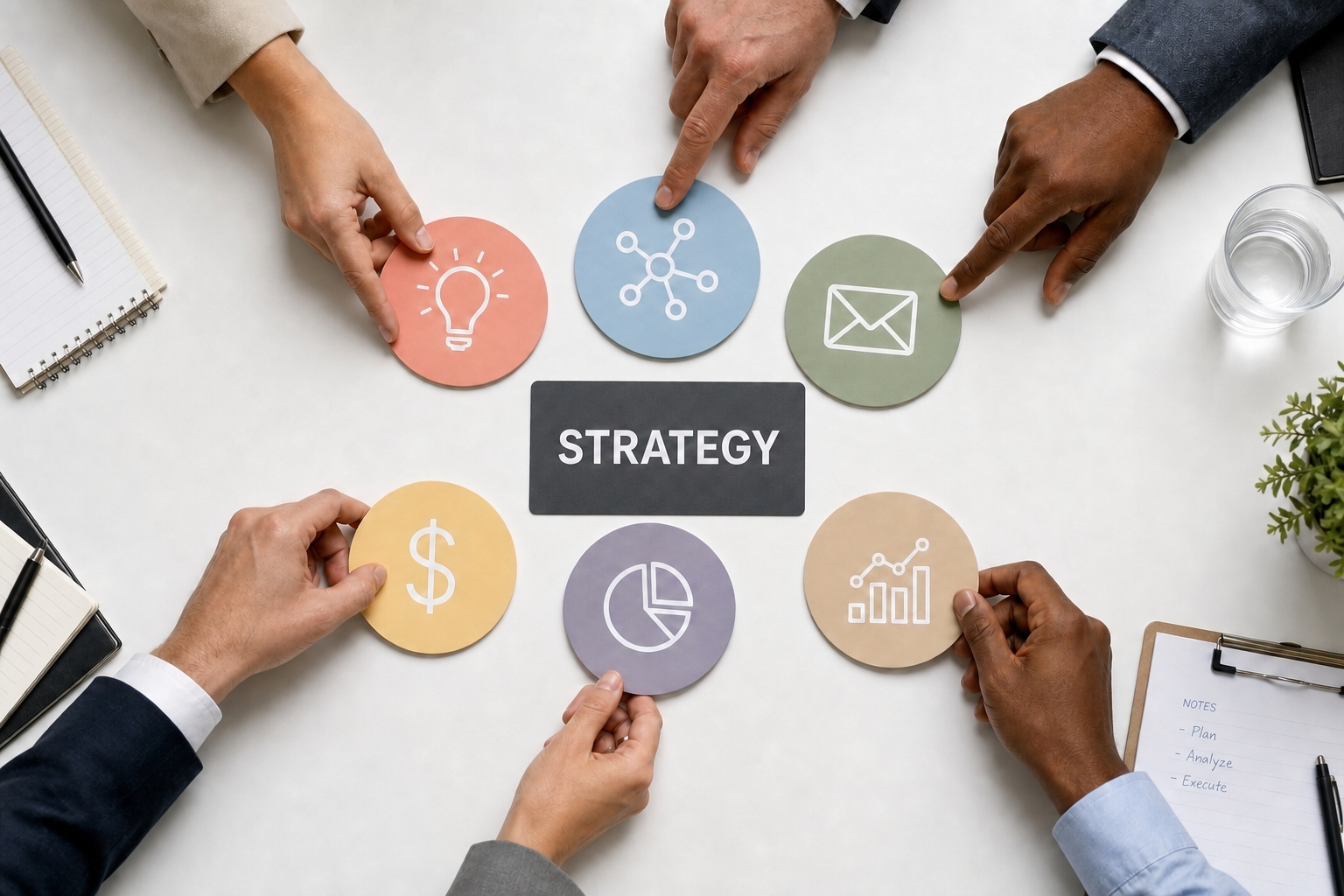
Thinking About Strategic Planning
I have been a fan of strategic planning for many years. In fact, that has been the case long before I thought an organization should have a strategic plan, and before the organization I was affiliated with developed one.
I am also a believer in the importance of strategic thinking as it applies to our personal and organizational lives. It’s not just about having a good grasp of what’s going on in our lives at the present time, but it’s also about anticipating and thinking about the future. It’s not about letting life just happen to us. It’s cataloging our hopes for the future in a thoughtful way.
Fundamentally, strategic thinking is about being aware and having a desire to do better. It’s about curiosity and inquiry (asking good questions), learning and growing, and altering the course of our lives as is appropriate. Obviously, strategic thinking is the other side of the strategic planning coin.
The Purpose of Strategic Planning
What follows are some thoughts regarding the importance of planning, including the critical dimension of both looking in and looking out of the corporate window. Many years ago, Harold Williams, who at that time was the president of the Rensselaer Institute, answered the following question for me: “What is the purpose of strategic planning?” His answer was straightforward: “To make and enable things to happen that would have otherwise not happened.” He views strategic plans as outcome-producing tools that allow organizations to achieve a preferred future across all the organizational dimensions, not just the financial ones.
Let’s look briefly at the strategic planning process. It should be noted that the following factors ought to be common ground for all those individuals, who may be working to develop a corporate strategic plan. The following are some factors that have made sense to me.
Key Factors in the Strategic Planning Process
- Awareness
Knowing where the organization is presently and how it is doing is vital. What are its strengths, its weaknesses, its performance gaps? How are the key performance indicators doing? Is the workforce engaged?
- Having a Commitment to Doing Better
Is the vision statement still relevant, current and supported by the employees? Does it continue to motivate them? How does the organization know it’s getting better?
- Being Curious, Asking Good Questions
Do employees practice the mission statement? Does the organization function with an acceptable handle on bureaucracy? How is the culture of the organization experienced? What is being achieved?
- Having Staff Members Committed to Learning and Growing
Are staff acquiring new and greater skills? What do clients or customers say about your organization? Are unwanted surprises occurring minimally? How are emergent problems dealt with?
- Altering Your Present Course as Advised or Necessary
It does no good to make the effort to bring people together, network with others, look at problems and opportunities, and develop a plan that is adopted enthusiastically, and then not follow it.
Common Reasons for Failure
Should implementation of the plan fail, it will likely be the result of one of three dynamics:
- The organization’s leadership was weak or failed to implement the plan.
- The Strategic Planning Development Committee did not give sufficient attention to the specific short-term action steps that needed to be accomplished sequentially or simultaneously in order to fully implement the plan.
- The strategic plan did not adequately deal with the implementation roles and responsibilities of staff or others, who were involved in or should have been carrying out the goals of the new plan.
Until next time,
Art Dykstra
LAUGH A LITTLE:

REFLECT A LITTLE:

Proverbs 18:24
One who has unreliable friends soon comes to ruin,
but there is a friend who sticks closer than a brother.
READ A LITTLE:

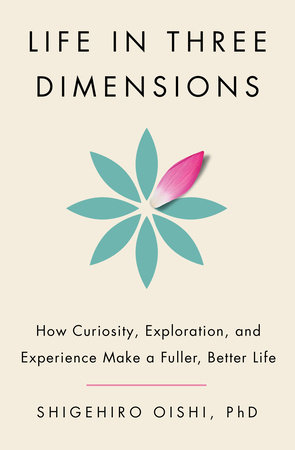
Life in Three Dimensions:
How Curiosity, Exploration, and Experience Make a Fuller, Better Life
Shigehiro Oishi
(Doubleday, 2025)
Shigehiro Oishi, PhD, a professor of psychology at the University of Chicago, has written Life in Three Dimensions essentially to add psychological richness to the two dimensions of meaning and happiness that are commonly regarded as helping one live the “good life.”
Happiness
He believes that “happiness is a subjective feeling that rises and falls to indicate where one’s life stands. It is a bit like a balloon. With the right wind and air pressure, it floats high. Smooth sailing. But when the weather is bad, it deflates. Grounded and stuck. Life is not going well. In another sense, happiness is like your batting average in baseball. It goes up and down, but what matters most is the frequency of your hits.”
Meaning
Oishi does not spend any significant time reviewing the concept of meaning but does devote one chapter to discovering the “meaning trap.” He claims that “recent studies have found that meaning in life is associated with right-wing authoritarianism toward those who violate social norms and strict conventional values.” He fails to state how it is “associated” or share which social norms are being violated. He contends that “the pursuit of a meaningful life can promote a narrow point of view.”
Psychological Richness
He offers the following rationale to persuade us to accept his view of a fulfilling life. “Yet by limiting ourselves to these two paths, we have put a good life out of reach for too many. There is another way to achieve a good life. It may not be stable or comfortable, but it is exhilarating. It may not be filled with contentment, but it is dramatic. It has ups and downs, twists and turns, and by the end of the ride it offers a life with fewer regrets; a life of adventure, playfulness, spontaneity, serendipity, and learning; a life of going with the flow, trotting the path less traveled— in other words, a life rich in experiences. This third way to a good life is the psychologically rich life, and it is a way to transcend the happiness and meaning traps.”
I’m not convinced, but I do agree that psychological richness provides another path to examine a desire to live a good life. My position, however, is that living our best possible life is found through meaning and purpose— primarily by serving others before we serve ourselves. With meaning, joy is always available to us.
I’m writing this review of Life in Three Dimensions so that you are aware that such a perspective is being shared and discussed. There are many other books I would recommend you read regarding the pursuit of a good life, but I do agree that adding psychological richness to your life will make it fuller.
What follows are some other insights from the book.
- “A psychologically rich day is a day when you experience something unfamiliar, feel a wide range of emotions, and gain a new perspective on life.”
- “Simplifying one’s life so as to have reliably positive experiences, or contentment, is key to happiness. Dedicating one’s life to others with compassion is key to meaning. Experiencing the unusual, challenging oneself, and learning new things—though frustrating and unpleasant at times— are key to psychological richness.”
- “Two main personality predictors of a psychologically rich life were openness to experiences and extraversion.”
- “Lightheartedness punctures the monotony and puts fun back into work.”
- “When you read a poem or see a piece of sculpture, you haven’t learned a new fact, but you’ve had a new experience.”
- “When faced with an actual choice, we tend to choose a sure “winner” rather than a risky product. We’ll settle for something familiar because trying something new is too much work. In the long view, we want novelty; in the short term, we want security. Familiarity is warm and fuzzy, and it has a surprising power over us, steering us away from psychological richness.”
- “Psychological richness is inherently intertwined with the quantity and quality of your stories. The more interesting stories you have, the more psychologically rich your life is. But, as Julian Barnes points out, ‘we tell our own life story differently at different times’” (Julian Barnes, The Sense of an Ending).