
LEARN A LITTLE:

Thinking About Words of Advice
Reference Note: this month’s blog is the first in a series of blogs that will probably deal with the subject of advice. We will take a look at this dynamic from a variety of perspectives and also include some samples of good advice.
As I have gotten older, more people have asked me the question, “What’s the best advice you have ever been given?” In actuality, it is not that easy for me to respond quickly. I’ve been given a lot of good advice—applying to many different dimensions of my life, including the aging process. If we think about it, we as fellow travelers have been given lots of good advice in our lives, and yes, some bad advice as well.
As I thought about my response to the question, it occurred to me that the best advice was frequently very contextual and in other instances, very broad and universal. Sometimes the advice had been given previously and was now a reminder.
Often times, I remember very well who shared particular advice with me, perhaps because the person was special in my life. At other times, I was struggling with a problem or difficulty, and the person was trying to be helpful.
As time has passed, I have come to understand that learning doesn’t just occur in response to problem solving or overcoming obstacles. It can also involve how we think about things or events, or how we might do things differently. Furthermore, good advice can help us grow, get better, be encouraged, or remember things we should be doing. In fact, some of the advice I have been given acted as a switch that turned on the light in the darkness for me.
I have compiled many journals over the years in which I have jotted down advice, observations, and thoughts about life as well as specific ideas regarding topics, such as leadership, culture, relationships, my faith and even things just to think about. I began keeping them because I know that we as human beings “leak, stray, and forget.” I am grateful for the advice that so many people have given me, but one does need to be discerning—sometimes the advice is off base and on other occasions, not helpful.
To bring closure to this blog, what follows is a sampling of valuable advice I have been given by specific people. I realize that some content may have been repeated from someone else or come from other sources. A few of the thoughts came from my father, who shared some great advice over the years. I must admit that at that time I didn’t fully understand or appreciate it, today I do.
I hope you will find this collection of thoughts interesting, enjoyable, and helpful.
- “If you are ever in a situation where you are “playing God” in someone’s life, take it seriously.”
- “Don’t go to bed at night while still carrying anger toward your wife/husband.”
- “Don’t put your kids before your wife or your marriage.”
- “Always be grateful.”
- “Trust in God.”
- “You will never be younger than you are, but you can always be wiser.”
- “’Well done’ is better than ‘well said.’” – Benjamin Franklin
- “It’s important to learn the trade, not just the tricks of the trade.”
- “Bees may not be as busy as you think they are. Perhaps they just can’t buzz any slower.”
- “Don’t forget to laugh.”
- “Your goal should be to be part of the strength of your organization, not a part of the weakness.”
- “Overcome the overwhelming before the overwhelming overcomes you.”
- “Don’t show your “butt” when apologizing.”
- “Don’t take a victory lap before the victory.”
- “Morning sets the feeling/tone for the entire day.”
- “If you stop to think, make sure you start again.”
- “You don’t fix a flat tire by changing the driver.”
- “There’s a difference between collecting dots and connecting them.”
- “Live simply, give more, expect less.”
- “Are you doing something today that will outlive you?”.
- “What we learn depends on the questions we ask.”
- “There comes a time when students can only learn if their teacher is not there to tell them what to do.”
- “Not all who wander are lost.” – J.R.R. Tolkien
Until next time,
Art Dykstra
LAUGH A LITTLE:

REFLECT A LITTLE:

Proverbs 10:23
A foolish person enjoys doing wrong, but a person with
understanding enjoys doing what is wise.
READ A LITTLE:

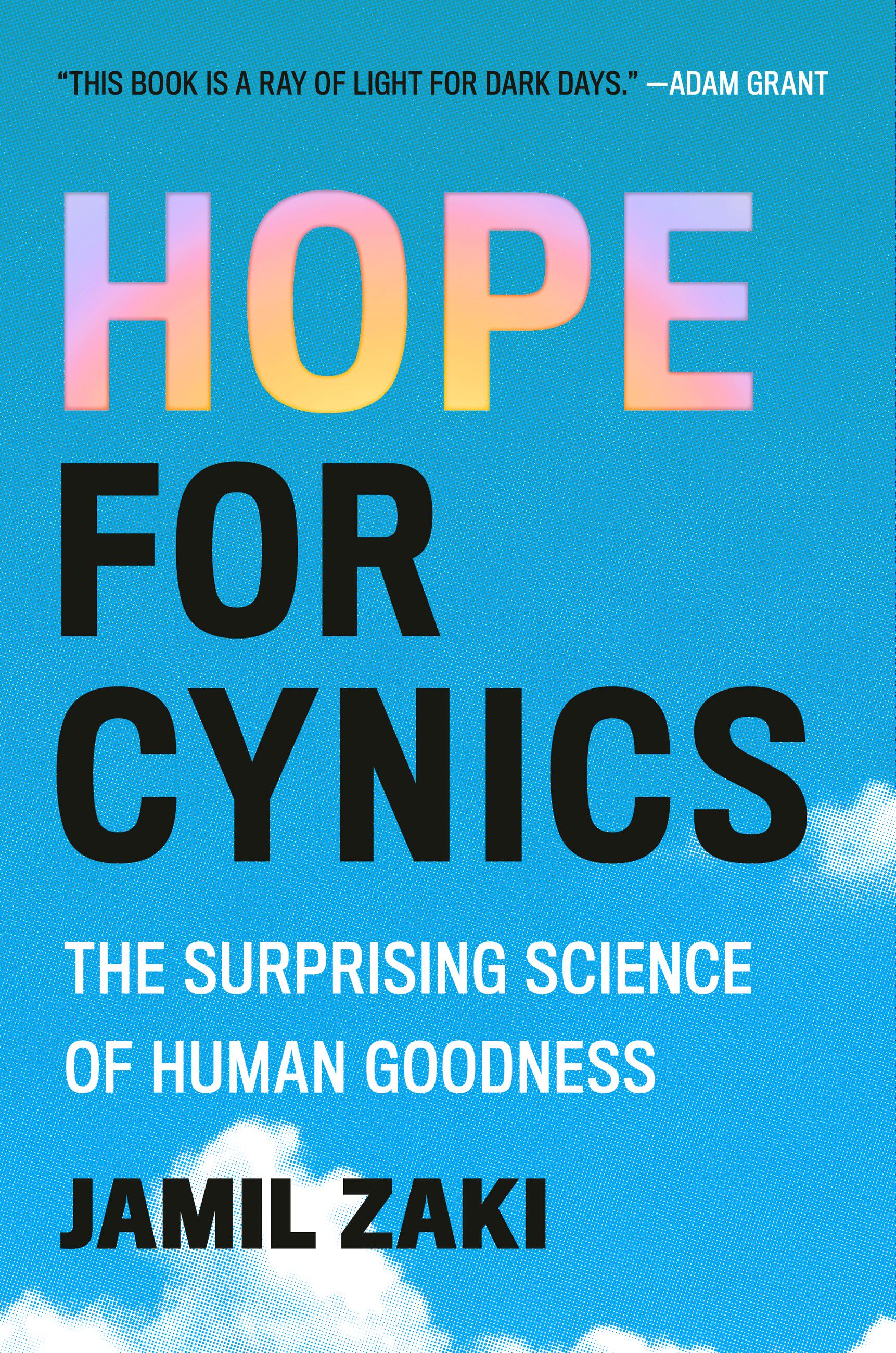
Hope for Cynics:
The Surprising Science of Human Goodness
Jamil Zaki
(Grand Central Publishing, 2024)
Thanks to Thane and Kim (my son and daughter-in-law) for giving me this book as a recent Christmas gift. It came at a good time, a time in our country, from my perspective, that has never been more cynical and replete with mistrust. The author, a professor at Stanford University and the director of the Stanford Social Neuroscience lab, is a self-confirmed cynic, who leans toward “doomerism”.
Hope for Cynics won’t interest everyone. In many ways, it’s more about self-awareness and self-leadership than it is about team leadership. While I consider myself blessed that I am an optimist and a hopeful person, who is inclined to trust others, I am aware that it is easy to become cynical. However, I believe everyone should know and be informed of the negative consequences of having a cynical worldview.
The book is well-written. I especially found the introduction to be quite helpful in laying out the foundation for a better understanding of the subsequent three sections.
The sections are:
1. Unlearning Cynicism
2. Rediscovering One Another
3. The Future of Hope
In the introduction, the author, Jamil Zaki, shares his own struggle with cynicism but also introduces the reader to a colleague, Emile Bruneau, a fellow psychologist, who had a great deal of influence on his thinking.
Some introductory thoughts are shared below.
- “There’s a difference between understanding something and feeling it.” Note: I would also add the notion of practicing it.
- Cynicism “wears away the psychological glue that binds us. By eroding trust, cynicism steals our presence together and dampens the futures we can imagine.”
- In a study done in 1972 by the General Social Survey, “nearly 50 percent of Americans surveyed agreed that most people could be trusted.” In contrast, “in 2018, only 33 percent felt that way.” A true “trust recession” had begun.
- “Between the 1970s and 2022, the percentage of Americans who trusted the presidency fell from 52 to 23 percent, newspapers from 39 to 18 percent, Congress from 42 to 7 percent, and public schools from 58 to 28 percent. Maybe we’re right to suspect politicians and cable pundits. But our collective cynicism has consequences.”
- “When trust is depressed, cynicism rises.”
- The fact is that “cynics suffer more depression, drink more heavily, earn less money, and even die younger than non-cynics.”
- “Our beliefs influence how we treat other people, which shapes how we act in return. Thoughts change the world, and cynicism is turning ours into a meaner, sadder, sicker place. We loathe political rivals, but more than 80 percent of us fear how divided we’ve become. Most of us want a society built on compassion and connection, but cynicism convinces us that things will get worse no matter what we do. So, we do nothing, and they worsen.”
- In the remainder of the introduction, Zaki turns to the alternative: trust, hope, optimism and the development of an effective mindset—hopeful skepticism. Hopeful skepticism is essentially “a reluctance to believe claims without evidenc”
- “Cynicism is a lack of faith in people; skepticism is a lack of faith in our assumptions.”
Given the attention I have given to the introduction, what follows is a selected overview of highlights from the three sections of the book.
Section I: Unlearning Cynicism
- “We all use theories to explain, predict, and move through the world. Optimism is the theory that the future will turn out well; pessimism is a theory it won’t. Optimists pay attention to good omens and take risks; pessimists focus on bad signs and play it safe. Cynicism is the theory that people are selfish, greedy, and dishonest. Trust is a social gamble, and cynics think it’s for suckers.”
- “Trust makes good times better and bad times better, too.”
- “If cynicism were a pill, its warning would list depression, heart disease, and isolation. In other words, it’d be a poison.” Unfortunately, a lot of people believe that there is a positive side effect of cynicism—intelligence. This is not the case.
- “Skepticism and cynicism aren’t just different. The first can be an antidote to the second.”
- “Cynicism runs in families, but less than half of it can be explained by our genes. Cynics are not born, they’re made, and our society is minting them.”
- “When you lead or care for someone, you create their ‘pre-existing’ conditions.”
This section concluded with a solid discussion of the dangers of social media, counting social comparisons, and even child-rearing dangers0. “Parents try to keep their children safe by making them feel unsafe.”
- “If bad news serves the greater good, it also makes for good business because it feeds negativity bias. A study of over one hundred thousand stories on the site Upworthy found that each negative word in a headline increased its number of views by 2 percent. By piling up alarming language, websites can drive much larger increases in traffic. Media companies being companies, they give people what they’ll buy. Over the twenty-first century, headlines have featured a steadily growing presence of negative emotions such as disgust, fear, and anger. Even songs have soured. Between 1970 and 2010, the mention of love in popular music dropped by 50 percent, while the use of “hate” tripled.”
Section II: Rediscovering One Another
- “Relationships falter when people don’t realize how much language can harm; cast-off insults by a parent, friend, or lover slip under our skin like a splinter. But how many relationships stall because we forget the good our words can do.”
- “In a recent study of health-care workers, the only factor that decreased cynicism was compassion towards others, not self-care.”
- A helpful thought: “The success of the group assures the success of the individual, but not the other way around.” – Bill Bradley
- Some good advice for “disagreeing better” is shared beyond the suggestion of spending time with people you disagree with.
1. “Good disagreers ask questions instead of making statements.
2. They work to get underneath people’s opinions to their stories.
3. When they spot common ground, good disagreers name it.
4. When they are unsure about something, they say so rather than pretending to be confident.”
Section III: The Future of Hope
- “New generations take for granted rights and abilities their ancestors dreamed of. Cynicism takes root in our amnesia.”
- “Cynicism tunes people in to their culture’s weaknesses but makes any cure seem impossible.”
- “Providing solutions in the midst of discussion of a problem helps people get engaged.”
A final bit of advice: “Don’t let cynicism become your default mode.”