
LEARN A LITTLE:

Thinking About Goals and Self-Expectations
Not long ago, a colleague and I were discussing goals and self-expectations. At one point, my friend paused and asked, “Aren’t your goals and self-expectations the same thing?” What’s interesting is that while I have thought often about self-determination. I don’t recall ever thinking about that question before. What followed was an enjoyable and thoughtful exchange of ideas.
My current thinking is that goals and self-expectations are different. Goals are things we wish to achieve, and self-expectations are about what we want to be.
All of us are aware of, and know people who are trying to live up to other people’s expectations for their lives. This occurs most frequently in families, both explicitly and implicitly. For example, a family member might say, “It would be great if you could find a job near us.” It could also involve career choice, college selection, decisions regarding your residence, or even the choice of a spouse. These are just a few of the many commonly experienced, family-generated self-expectations.
As a background thought, I’m aware of the fact that as people, we vary greatly with respect to the interests that we have in such questions. For those who work in what we refer to as the “helping professions,” thinking about such questions is most relevant to personal growth, and assisting others to live a flourishing life.
From my perspective, self-expectations, like other human behaviors, are not static. They can indeed change over the course of our lifetime, just as our lives go through phases or cycles as we get older.
Self-expectations can be seen from three different perspectives.
- A prediction regarding myself, “I expect to do well at this.”
- A requirement I impose on myself, “I must do well on this.”
- A standard for how I want to behave, “I expect myself to treat people kindly.”
As a result, self-expectations can be seen to serve as a compass, and goals more like a destination. Self-expectations are not goals per se, but they can lead to the development of goals. Self-expectations, while being “weighed,” are not typically measured. Goals, on the other hand, work best when they are measured.
In concluding these thoughts, it must be realized that self-expectations and goals can sometimes conflict with each other, or be in misalignment. An example of this situation might be the self-expectation of being kind and considerate, and the organizationally given goal to reduce the size of the work force. Such tensions could even account for certain avoidance behaviors in our lives.
It’s best when goals and self-expectations are in alignment. In this situation, a person is much more likely to feel confident living a life with a sense of direction and purpose. This reflects Kennon Sheldon’s research on self-concordant goals, which indicates that people who pursue goals aligned with their values and interests persist longer, and they are more likely to reach them and gain greater well-being than those people pursuing goals driven by external pressures or guilt.
Until next time,
Art Dykstra
LAUGH A LITTLE:


REFLECT A LITTLE:

Proverbs 10:4
Lazy hands make for poverty, but diligent hands bring wealth.
READ A LITTLE:

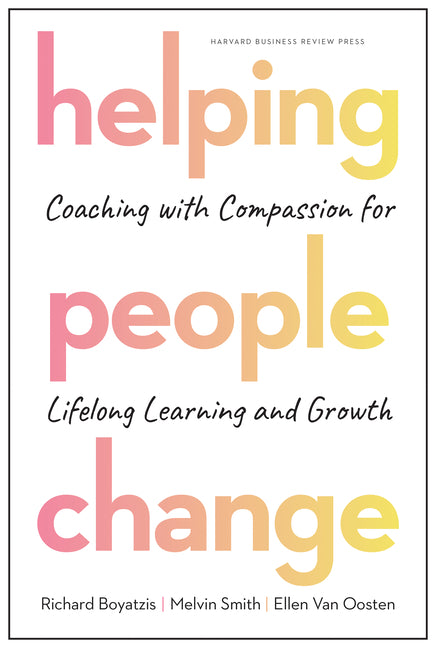
Helping People Change
Boyatzis, Oosten, and Smith
(Harvard Business Review Press, 2019)
Helping People Change was published in 2019 by three professors who are faculty at the Weatherhead School of Management at Case Western Reserve University in Cleveland, Ohio. It is an easy-to-read book, less than 200 pages and lives up to the title of Chapter 1, The Heart of Helping—How to Really Help Others Learn and Grow.
While it is primarily directed toward those most interested in coaching, it is, as the authors have stated, a book for anyone who wants to help people—“coaches, leaders, managers, counselors, therapists, teachers, parents, clerics, doctors, nurses, dentists, social workers, and others.”
I believe they have done it through combining science and research with stories and personal examples. Each chapter concludes with an effective summary and exercise: key learning points, reflection and application, exercises, and conversation. The book is packed with practical suggestions and insights. It is not a book that you would just want to read through and be finished with, especially if you are an individual engaged in the dynamics of helping others. There is much to think about and many opportunities for growth and practice.
What follows is an excellent summary of the book intent:
“Coaching with Compassion
We’ve based this book on the premise that, when done effectively, coaching and helping all kinds create three specific changes in people seeking help. First, they will find or reaffirm and articulate their personal vision, including dreams passion, purpose, and values. Second, they will experience changes in behavior, thoughts, and/or feelings that will move them closer to realizing their personal vision. And third, they will build or maintain what we call a resonant relationship with the coach or helper and ideally with other supportive people in their lives.”
Selected Highlights and Insights
- “Great coaches and the best teachers, colleagues, and friends engage us in conversations that inspire us. They make us want to grow, develop, and change in meaningful ways, and they help us to do so. They help us pursue a personal vision rather than merely to dutifully fulfill a life of should and oughts.”
- “Coaching, when it is most effective, is essentially about helping another person change, learn, or grow in some way. It is about helping people figure out what might be possible or desired in their lives and then helping them figure out how to achieve it.”
- “When coaches are mindful, they are fully present with the person they are coaching, staying in the moment with full and conscious awareness. They are completely tuned into that person and what they are saying, as well as what they seem to be feeling. Coaches who are mindful are also very self-aware, understanding what they are personally thinking and feeling at any given moment and being careful not to project their own thoughts and feelings onto the person they are coaching.”
- “Even with a deep sense of meaning and purpose, however, people rarely can move forward unless they also feel hope. Effective coaches therefore help create that sense of hope.”
- “People tend to change their behavior when they want to change and in the ways they want to change. Without an internal desire to change what or how they behave, any noticeable differences are often short-lived.”
- Trusted individuals can also serve to nurture us through the change process. Often identified as “accountability partners,” their job is to “hold us accountable for the changes we want to make.”
- Two important concepts are given major attention throughout the book, PEA—positive emotional attitude and NEA—negative emotional attitude. “The PEA enables us to thrive by activating and renewing stress-alleviating hormones that produce feelings of safety, hope, and even joy. The NEA helps us survive by activating our stress hormonal response to a threat, namely fight, flight, or freeze.”
- “We need the PEA more often than we think. Most of us tolerate negative environments and relationships—sadly, we have come to expect them. Research on states described by the PEA and NEA suggests that, for sustainable change, a person needs to be in the PEA two to five times the frequency or amount of time as in the NEA.”
- “A person’s vision is her image of a possible future. It is not a goal or a strategy. It consists of neither actions nor obligations. It is not a forecast of what is likely. It is a dream!”
- “A personal vision is an expression of an individual’s ideal self and ideal future. It encompasses dreams, values, passions, what a person desires to do, but also who she wishes to be.”
- “The relationship between a helper of any kind and the individual being helped is the heart of any change process.”
- Throughout the book, the authors describe the importance of the coaching conversation, “The frame of mind and emotional state of anyone who tries to help another is fundamental to how the conversation will unfold.”
An Assignment:
Something for you to figure out:
What do you think the authors were addressing when they stated, “Consider your approach to coaching as a chance to mine for gold, not dig for dirt?”