
LEARN A LITTLE:

Is There Something Driving You Crazy?
I trust you will overlook my non-professional use of the word “crazy”, but it helps cut to the chase and capture something I have been observing on a much more frequent basis. People seem to be in a much greater hurry today than in times past. It’s crazy.
There’s even a new name for the disorder currently out there-it’s diagnostically referred to as “hurry sickness.” You can notice the disease sufferers rather easily. They are on the highways, in the lines at grocery stores, in meetings, in restaurants, on the golf course, and out of the mouths of those who talk to their iPad or computers-“Come on.
Come on. What’s taking you so long?” Sometimes you experience the institutional side of “hurry sickness” in doctor’s offices where 15 minutes is apparently enough time to address any medical condition.
There is nothing wrong in wanting to do something quickly, as for example, finding out that you wrote down the wrong due date for an important assignment at work and now have to act swiftly to meet the deadline.
Rushing through life, however, carries consequences with it, physical and medical as well as psychological and behavioral. And often, at the same time, alienating or neglecting the very people you care about.
There is a growing body of evidence from the research being done with respect to “hurry sickness.”
- Impatience seems to spawn high blood pressure, head aches and anxiety.
- Stress is a common accompaniment.
- Difficulties in sleeping–and now you begin to worry about your low sleep scores.
On the behavioral side, people who can’t seem to get out of the “hurry” cycle often have a problem saying “no”, have no ends to their “to do lists”, frequently miss breakfast, and often have a problem sorting major things from minor things.
The list goes on, the person may have more frequent instances of anger outbursts, be seen as a person who is not a good listener, prone to worrying-many times about what they still have to do, or it seems to them they can’t put anything on the back burner.
Now the fact of the matter is that each of us may go through periods where we worry and exhibit the symptoms of “hurry sickness”— Christmastime may be a good example.
Not being a “hurry sickness” therapist, I only have a few suggestions: spend more time doing self-awareness exercises-check in on yourself. Where do you find yourself? Where do you find yourself on the “Swiftness Scale”? Slow down, take work breaks, “stop and smell something”, even if it isn’t roses.
Until next time,
Art Dykstra
LAUGH A LITTLE:


REFLECT A LITTLE:

Proverbs 16:8
It is better to have a little, honestly earned, than to have a large income, dishonestly gained.
READ A LITTLE:

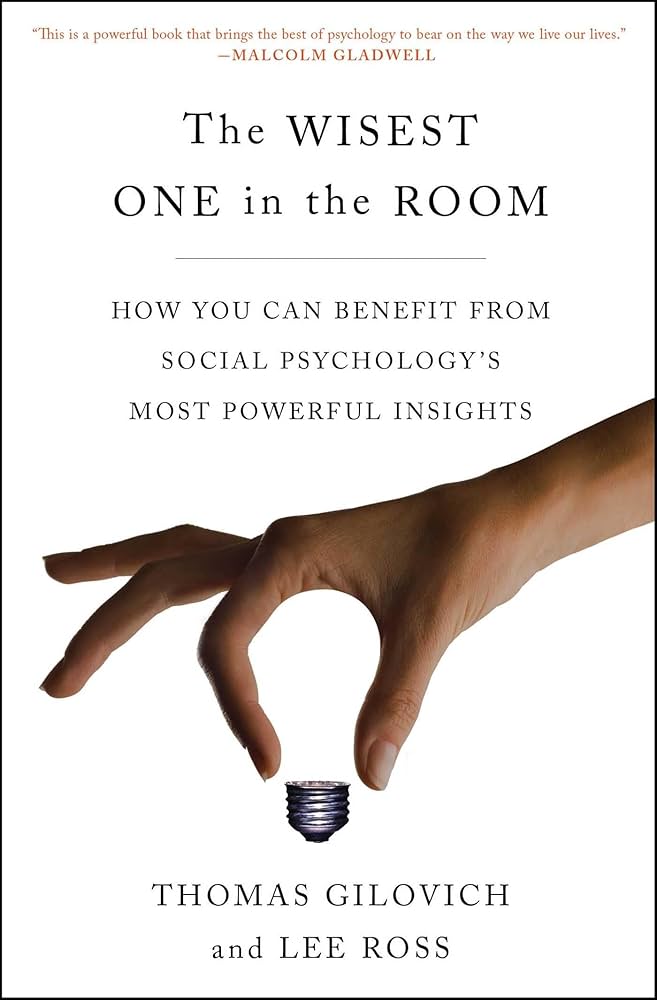
The Wisest One in the Room
Thomas Gilovich and Lee Ross
(Free Press, 2015)
The Wisest One in the Room, written by Thomas Gilovich and Lee Ross, was first published by the Free Press in 2015. Both of the authors are psychologists, professors, and well-known authors.
I found the book valuable from the perspective of learning more about human behavior and gaining additional insights with respect to why we do what we do.
Part 1 of the book resonated the most with me— Pillars of Wisdom: The Objectivity Illusion, The Push and Pull of Situations, The Name of the Game, and Keyholes, Lenses, and Filters. Part 2, Wisdom Applied, was also helpful and engaging— The Happiest One in the Room, Why We Don’t “Just Get Along”, A Tough Problem for America, and An Even Tougher Problem for the World.
In many aspects, the issues identified in the chapters are still relevant today, but the world is in many ways different in terms of increased turmoil, the increasing impact of social media, and now the rapidly growing impact of artificial intelligence.
Part I: Pillars of Wisdom
A few comments regarding wisdom. Wisdom in this book is viewed through the lens of social psychology. For them “to be wise”, one must be “psych-wise” and be able to “put individual events in perspective to take a broader view of the issue at hand”.
Chapter 1: The Objectivity Illusion
- A key thought of the chapter and the book is very well laid out. We as people “have the tendency to trust our sense of what’s out there as a matter of objective perception” rather than subjective interpretation. This fact lies at the root of many types of human folly.
- You will come across the term “naïve realism” many times in the book. It is the notion that our personal views of reality— how we see things— is correct and accurate. “We pay the price for assuming that our own assessments are better than those of other people with similar information and expertise.”
- By “the wisest one in the room”, we “do not mean the person with the highest IQ or the greatest command of facts and figures. The wisest one in the room experiences discernment and good sense. The key concept, “you can’t be a wise person if you aren’t wise about people.”
Chapter 2: The Push and Pull of Situations
- “People are more susceptible to subtle situational influences than most of us realize.” The authors cite the well-known research example of the Princeton Divinity students.
- To amp up motivation, “identify and then eliminate the obstacles standing in the way of desired behavior”.
- “Once a person gets going in the desired direction, it’s easier to keep going.”
- The authors also spent considerable time describing the Fundamental Attribution Error, the tendency for people to overestimate personal deficiencies and under emphasize situational factors when observing the behavior of others.
- The chapter concludes with further examples or errors in judgment primarily because situational factors were overlooked. “The wisest person in the room takes a close, detailed look at what can be done to change the situation— what barriers and disincentives need to be removed and what can be done to make desirable and constructive actions easier, and undesirable and destructive actions more difficult.”
Chapter 3: The Name of the Game
- “The names we give to plans, policies, and proposals determine what associations and images come to mind when we think about them.”
- “Political activists across the ideological spectrum battle to control the images and associations we connect with particular threats. Excess meanings are exploited with great success.
- “Because people respond to their surrounding circumstances not as they are but as they are interpreted, the judicious use of terms and labels can determine the nature of the situation to which people believe they are responding.”
- In the context of labels and defaults, “people respond to their subjective interpretations of objective circumstances not to the objective circumstances themselves.”
- Many variables determine how people assign meaning to different circumstances. Among them are context, habit and experience, motivation, and temporal proximity. “When looking far off in the future we see the forest; when looking close at hand, we see the trees.”
Chapter 4: The Primacy of Behavior
- “The idea that our emotions might be heightened or damped or completely transformed by altering our physical actions has proven to be sound.” (William James)
- “People’s behavior is often more predictive of their attitude than attitudes are of their behavior.”
- “What we get from introspection is indeed weak, ambiguous, and uninterpretable far more often than most people imagine.”
- “The key to reaching difficult long-term goals and developing the necessary values and motivation is to ‘get the ball rolling’.”
Chapter 5: Keyholes, Lenses, and Filters
- “It is easy to be blinded by ideology. Ideologies and preconceptions are lenses and filters. They make it easy to see and grasp some things but harder to see and understand others.”
- “The wisest in the room understands that the information most readily available is often not the best guide to effective action and therefore takes some simple concrete steps to get a broader, more complete, and more accurate view.”
- “The intuitive mind is more impulsive than the rational mind, and more likely to act— to render a judgement and lean toward a course of action— without surveying information beyond its immediate attention. This helps explain some of the most common errors of everyday judgment: specifically, that many mistakes are made not because the right answer is too hard but because the wrong answer is too easy.”
- The confirmation bias: “The more you want a proposition to be true, the more inclined you are to look for evidence that supports it.”
Part II: Wisdom Applied
Chapter 6: The Happiest One in the Room
- “In the face of adversity, adaptation is our greatest asset.”
- “Eudaimonia— the broader sense of well-being that comes with the feeling that one’s life is worthwhile, meaningful, and well-lived.”
- “The wisest in the room appreciates the implications of this focusing effect when making personal decisions and offering advice to friends.”
- “There is a pretty high correlation between how happy people say they are and how happy their friends and coworkers say they are.”
- There are things a wise person does to be happier:
- “Act like a happy person, and you will find it easier to be one.
- Don’t waste your energy denigrating paths not taken or choices not made.
- Avoid social comparisons that put you at the short end of the stick.
- Savor the great times you had and the blessings you enjoyed in the past rather than dwelling on what may be lacking in your life today.
- Seek out experiences that will contribute to your happiness right now.
Unfortunately, this sort of advice is much easier to offer than to follow.
- Commonly reported regrets: “Most of us tend to focus on things that we failed to do rather than things we did but turned out badly.”
- “If you are feeling a little blue, it is wise to do Go for a walk, call a friend, start that classic novel you’ve long intended to read, plan a dinner or vacation, or better still, look for a way to make someone else a bit happier.”
- “Older people have more of a knack than the young for thinking about outcomes and events in ways that promote happiness. The happiness that older people enjoy is indeed more centered around serenity than excitement.”
Chapter 7: Why We Don’t “Just Get Along”
- “Disagreement and conflict between individuals, groups and societies have always been an inescapable fact of human existence.”
- “Parties who disagree about matters that are important to them inevitably feel that the disagreement is the result of the other part not seeing things objectively and reasonably.”
- “The most important barriers to agreement, or at least the most difficult to overcome, are often psychological. -President Sadat”
Chapter 8: A Tough Problem for America
This chapter primarily deals with the effects of stereotypes on performance, namely in the field of education.
- “Psych-wise parents do not tell their children how smart or accomplished they are. Instead they praise hard work and the willingness to tackle difficult challenges.”
The remainder of the chapter offered “wise interventions” for academic performance impairment.
Chapter 9: An Even Tougher Problem for the World
This chapter is essentially about the problem of climate change. It is clearly recognized as a very significant political problem.
- A significant challenge in resolving the climate change problem is that it “demands that people make personal sacrifices now to minimize harm that others will suffer in the future.”
The remainder of the chapter outlines still more challenges and hurdles. As you might have anticipated, no real articulate course of future action was identified or proposed.